
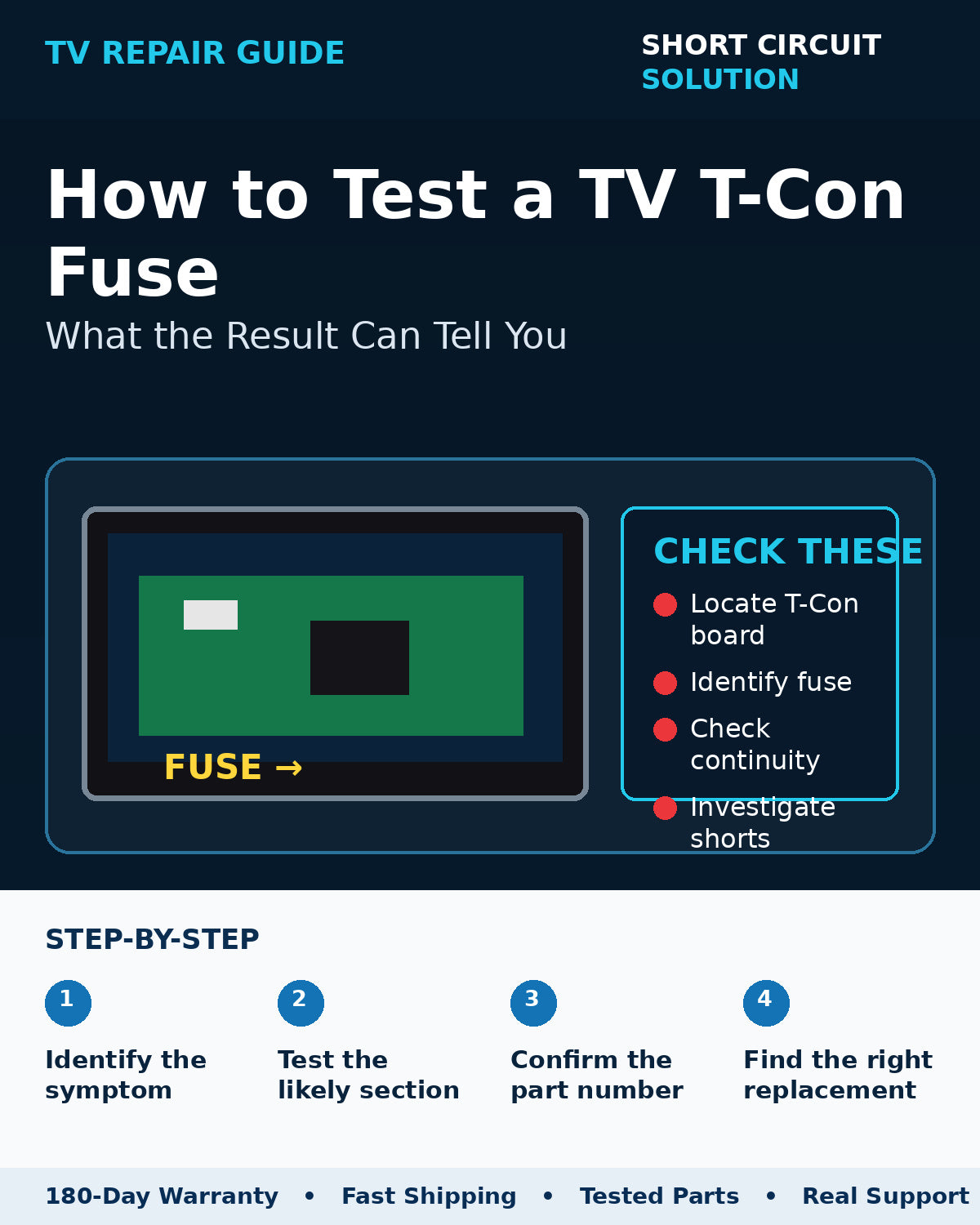
The small surface-mount fuse on a TV T-Con board is a useful checkpoint when a TV has backlight but no normal picture. Testing it can tell you whether power is reaching the T-Con and whether the board may have an internal short.
Locate the T-Con safely
The T-Con is often mounted near the top or center of the panel and connected to the display by flat ribbon cables. Some TVs integrate the timing-control circuitry into another board, so not every model has a separate T-Con.
Check continuity with power removed
With the TV unplugged and discharged, a good fuse should normally show continuity from one side to the other. An open fuse indicates it has blown, but the fuse itself may not be the root cause.
Check voltage on both sides when appropriate
For technicians comfortable with live measurements, checking for the expected supply on both sides of the fuse can show whether power is reaching the board. A correct input on one side and no voltage on the other confirms an open fuse.
Do not simply bridge a blown fuse
A fuse usually opens because of excessive current. Replacing or bypassing it without checking for a short can damage the board or other components. If the fuse is good but the picture remains abnormal, continue with T-Con, ribbon, and panel diagnostics. See our T-Con guide.
Before you order a replacement
Photograph the original board label, the TV model/serial label, and the connector layout. Compare those details to the replacement listing and avoid ordering only from appearance. If you are unsure, contact us with the photos before purchasing.
Short Circuit Solution stocks tested TV parts backed by our 180-Day Warranty. Match the exact part number whenever possible, and contact us if you need help confirming compatibility.
Safety note: TVs can contain hazardous voltages even when unplugged. If you are not comfortable working around electronic power supplies, use a qualified technician.